Susie Guenther Loewen recently wrote a thoughtful blog post entitled The Gap in Mennonite Literature in which she lamented the thin to nonexistent portrayal of Mennonite theology in most contemporary Mennonite literature. While she does not wish to negate the difficult experiences of coming to voice articulated in this literature, such as Nomi Nickel's experience in A Complicated Kindness by Miriam Toews, she notes that younger Mennonites often find a supportive community in their Mennonite heritage for artistic creation. Her solution--more Mennonite writing from a new group of writers!
What do you think? Have you noticed this gap?
How does the Mennonite literature you've read contrast with or illuminate your own experience as a Mennonite or with Mennonites?
Does it serve to reinforce stereotypes or to open new perspectives?
When a literature is labeled as "ethnic" or "cultural," does that mean its theology will be of minimal significance?
Can creative, vibrant theology find its way into literature?
Does Mennonite Literary creation depend upon the portrayal of an "oppressive" religious structure that must be overthrown to liberate the "individual voice?"
Sunday, October 30, 2011

Thursday, April 28, 2011
Mennonite Hospitality
After reading about food and fellowship all semester, it seemed like a natural idea to have a class potluck. "Bring a familiar food from your family," I asked students, not wanting to specify an exclusively Mennonite cuisine. After all, potluck should include some personal variety and there are many "Mennonite" foods that Mennonites have never prepared or tasted. It was great fun to sit around my kitchen table as people began to gather and we peeked under the aluminum foil and saran wrap of the dishes people brought.  Only the main dish was missing--the famed "borscht." Jamie brought sweet tea. Sarah brought bread fresh out of the oven. Kim brought her mother's bread pudding. The other Sara brought peanut butter cookies. Annie brought an apple salad with a peanut butter and mayonnaise dressing that was a delicious surprise. I had a pot of beef stew and a leafy green salad tossed and ready. While the class nibbled on some appetizers and chatted with each other, I noticed another visitor waiting outside: a large, lone Canada Goose. He strutted back and forth at the edge of the lawn. Then, as we watched through the kitchen windows, he began to stride towards the house. Just then Becca and Kate drove up with the borscht. I ran to open the door, but at about the same time, the goose decided to head towards the door as well. Kate, with a huge orange pot of steaming borscht, found herself being chased by the goose in full attack.
 "Run," we all screamed, and she made it, borscht intact, just as I slammed the door on the irate goose.
 Becca found her way around to the back door and managed to bring the shoofly pie with her. I found a quote from Sandra Birdsell's Katya echoing in my head: "Inside is inside . . . Outside is outside." I had wanted an inclusive table, but the goose had pointed out to me that even I draw the line somewhere. After such a rude dismissal from the Mennonite potluck, though, he disappeared. Joshua arrived after all of the excitement with a crockpot of scalloped potatoes--his mother's recipe--in his backpack and didn't have any goose action at all, even thought the potatoes were delectable. So, of course, we got to tell him the story. Thus Mennonite literature is born.


Tuesday, April 19, 2011
Pacifism in Mennonite Literature
Again and again in the Mennonite fiction we have read this semester, various arguments surrounding Jesus's teaching on peace and the Mennonite stance against war have come up for discussion. Both Peace Shall Destroy Many and Katya bring up pacifism in light in the context of war. A Complicated Kindness does not address pacifism directly, but rather portrays a community that purports to be based on love, but which in fact cares more about obedience and conformity than forgiveness and compassion. These three novelists--Rudy Wiebe, Sandra Birdsell, and Miriam Toews--respect the teachings of Mennonites on peace, but they are also realists and students of human nature. They know that humans mess up--a lot--and that human communities are also subject to human flaws. Thus in these novels human nature, over and over again, clashes with the religious and ethical ideals of peace, love, and forgiveness. The characters in these novels live in worlds where warfare, aggression, greed, inequality, lust, fear, violence, loneliness, and the desire for power run rampant. Because Mennonite communities are human, these impulses are found there as well. Thus the novelists call the Mennonite community to account for its beliefs--not just in the form of following traditional rules, but in the form of expressing Christ's love in the world.
According to theologian Ted Grimsrud, "Pacifism" is the belief that nothing is as important as love, kindness, and peaceableness. In a 2001 article in Mennonite Life, Grimsrud, who was not brought up in a Mennonite home, explores the meaning of Pacifism in the post-modern world in this article. Grimsrud's parents were both veterans of World War II, but when Grimsrud became a Christian at age 17, he began to read the teachings of Jesus and take them seriously. A few years later he realized that he could never kill another human being. Thus he calls himself a Christian pacifist. He discovered the Mennonite teachings on peace later in his life. For Grimsrud, being a pacifist is a central organizing principle that involves an understanding of God as reflected in the teachings on love and peace. He writes: "The peace which pacifists love is not simply a lack of violence. It is wholeness, harmony, restoration of relationships, healing of brokenness."
Whether or not we always agree about Mennonite teachings on peace, it is important to understand and respect these beliefs as part of the culture we are studying and how they impact the lives of the characters in the novels we've read.
One of the most important Mennonite writers on peace is not American or Canadian, but rather Japanese. Yorifumi Yaguchi grew up in Japan during World War II. He was taught to worship the Emperor and to hate the Americans. He saw members of his village die in the war and he saw the effects of the war ravage his country. His grandfather was a Buddhist priest, but he was disappointed in Buddhism because, although it is a religion of peace, it could not withstand the force of the Emperor who wanted to go to war, and the Shinto cult that taught the "divinity" of the Emperor before the war. Yaguchi was also disappointed in Christianity, because he believed it was a warlike religion. Then he met some Mennonite missionaries to Japan, and became converted through their ministry because they believed that the gospel of Christ was a gospel of peace.

Yaguchi also became a poet, and in the 1960s he came to America to study at the Mennonite Seminary, which was then in Goshen. While in Goshen, he published several books of poetry with Pinchpenny Press that reflected his religious conversion and his experiences with war--and later, teachings of peace. Yaguchi, who was a professor of American Literature in Japan, invited many famous American poets to his University to speak, including Anne Sexton, Gary Snyder, William Stafford and others. His poetry and his life are recounted in his recent memoir, The Wing-Beaten Air. His poetry, translated into English, has been collected and edited by Wilbur Birky, Goshen College Professor Emeritus. Yaguchi is concerned that in our war-like era Mennonite poets in the US and Canada are not more interested in peace. Yaguchi has been a tireless worker for peace in his own country, most recently protesting the requirement that all Japanese High School teachers sing the National Anthem, which has resurrected the cult of the Emperor, and teach it to their students. You can read a sample of Yaguchi's poetry and a memoir of a trip he and Wilbur Birky took to Japan in the Yorifumi Yaguchi issue of the CMW Journal, as well as a review of The Wing-Beaten Air. Here is one of Yaguchi's poems from that issue.
Two Mennonite Writers win Three Top Awards in Manitoba
David Bergen and Dora Dueck took the honors on April 18th, when at Manitoba's annual book awards event. Read about it in the Winnipeg Free Press.


Dueck won the McNally Robinson Book of the Year award for her novel, This Hidden Thing, that tells the story of a young Mennonite immigrant woman who "works out" as a domestic servant to earn money for her poor family and whose life is dramatically changed because of it. I was fortunate enough to preview this book and found it captivating. Here's what I wrote about it for the publisher, Canadian Mennonite University Press:
"This sweeping novel covers three generations of Canadian Mennonite history, focused through a young Russian Mennonite immigrant woman whose life is irrevocably changed by her “working out” in Winnipeg to support her family. As an accurate and vivid evocation of time and place, This Hidden Thing not only reflects Mennonite cultural change, but also records cultural change among English immigrants to Canada as their lives intersect with Mennonites. But above all, this is a novel of character.
Dora Dueck’s articulation of the reflexes of personality and the development of consciousness creates a drama of emotional tension and continuous discovery as she tells a compelling woman’s story too often obscured by history. She inhabits her characters in such a way that the reader is drawn into a living, breathing world that lingers even after the covers of the book are closed. This Hidden Thing offers a worthy female, urban counterpart to Rudy Wiebe’s Peace Shall Destroy Many."


David Bergen won two awards for his sixth novel, The Matter with Morris, which was also a finalist for the Giller Prize, one of Canada's top literary honors. I haven't read The Matter with Morris yet, but it explores the life of a man whose son goes to war in Afghanistan. I met Bergen on the Manitoba Author's tour at the Mennonite/s Writing: Manitoba and Beyond Conference at the University of Winnipeg in 2009, and found him to be both personable and funny. He's the unapologetically worldly son of a Mennonite minister, the happily married father of four children, and the winner of multiple awards for his writing. I found his novel, The Case of Lena S, to be both readable and provocative. Bergen is gifted at describing domestic relationships in slightly disturbed families and portraying the complex and unsolvable riddle of ordinary life. His short story collection, Sitting Opposite My Brother, his first published work, is still one of the finest contemporary Mennonite works in this genre.
In his recent essay, "A Complicated Kindness: The Mennonite Contribution to Canadian Literature," German scholar Martin Kuester says, "I believe . . . that new identities—whether resulting from language or narrative traditions—will, perhaps, counteract the disintegration [of commonly held Mennonite values] "that in the past held scattered groups of communities together." Kuester is hopeful that storytelling itself will serve as a force for renewal among Mennonites. "The telling of stories thus becomes a central motif not only in the form of Di Brandt’s “maternal story-telling” but also in Miriam Toews’ “Mennonite existentialism.” We are told the story of a community which is slowly liberating itself from oppressive master narratives but which, in both the literal and metaphorical senses, at all times and everywhere, is threatened by the floods that modern life brings with it."
What do you think? Will the continuing development of Mennonite literature serve as a force for renewal within this small cultural minority, or will it only serve to separate contemporary readers from the tradition by critiquing aspects of the culture that seem outmoded?
Sunday, April 17, 2011
Final Exam Question on Canadian Mennonite Novels
Each of the Canadian Mennonite novels we've read in this class focuses on the "coming of age" of the protagonist, and shows how that character develops increased self-awareness in relation to a series of obstacles related to the main conflict. So far, this is pretty much what all realistic novels do. So what's particularly "Mennonite" about these novels?
For one thing, these main characters are engaged in conflicts within the context of their Mennonite communities. These are "realistic" novels, so the conflicts are grounded in particular historical, cultural, and social contexts. Katya portrays the plight of the Mennonites caught in the Russian Revolution, Peace Shall Destroy Many examines a small immigrant farming community during World War II, and A Complicated Kindness shows a contemporary teenager trying to figure out who she is in a Mennonite Village that boasts a museum of Mennonite immigrant days.
Each of these novels shows both the character of a Mennonite community--and Mennonite characters-- those who negatively distort Mennonite values, as well as those who attempt to live a faith that emphasizes, selflessness, love, nonviolence, and obedience to Christ's teachings. The protagonist is typically caught in the tensions of the community even as they struggle with their own personal challenges. Through the portrayal of both personal and community conflicts, the authors of these novels raise questions for the reader about Mennonite community.
So, your exam question is: what is that central question raised by each novel? What answer do you think the novel suggests to this question, or how would you answer that question, based on your reading of the novel? In the body of your paper use textual evidence to support your choice of question as it pertains to one of the novels. In your conclusion, address how similar or different the three questions are that you see raised in these novels, and note any connections you see between them.
Some questions to ask yourself as you brainstorm and plan your response: What does the novel ask of the reader? What do you think motivated the writer to put the effort into exploring these particular conflicts in this way? Why do you think the novel ends where it does? The best answers will be precise, thoughtful, specific, and supported with textual evidence (even though this question is necessarily broad and general).
Example of how to use textual evidence to support your choice of question:
Stephen Byler's novel of stories, Searching for Intruders, raises the question of how we (men, in particular) should act in the world, given an awareness of violence inherent in male socialization. Byler's protagonist, Wilson Hues, is a sensitive and observant man in his twenties who has difficulty acting in situations of conflict. In the course of his life, Hues encounters a number of men who express interpersonal violence and attempt to pass on sexist values to the young men in their charge. First of all, Hues is the son of a successful but abusive man who has divorced his wife and has tried to socialize his son to be cruel to weaker creatures. Secondly, he plays tennis on a college team with a sexist and somewhat sadistic coach, who encourages the boys to haze each other and who, in particular, harass Hues about his sexual experiences with his girlfriend. However, Byler does not simply blame the negative role models in his life, but explores the ways in which the images of violence he has internalized affect his thinking and thus his actions. When he has sex with Melody, his girlfried, for the first time, it is in the wake of harassment by his teammates and coach; he ends up lying to her in what she believes to be a pure moment and she never forgives him. Melody has her own issues, and their relationship ends as Melody becomes self-destructive, but Hues does not shirk his own sense of responsibility for contributing to her pain. Moreover, Hues appears to have a need to reconcile himself with these negative images of masculinity, especially those he has experienced as his father's son. Halfway through the book, we discover that Hues's father has been killed in a small plane accident, but first he suffers cruelly from electrical burns over most of his body. The family, not wishing to relinquish their patriarch, tries to have every medical intervention taken to prolong his life, only adding to his suffering. Thus Hues contributes, unwillingly, to the suffering of another. The suffering of the father seems to be a pivotal point in the book. Hues turns towards a relationship with a new woman, Alethea, in the second half of the book as well. Alethea is suffering from cancer, and eventually dies of a relapse, but Hues's relationship with her is more mature than his relationship with Melody. Both strive towards an appreciation of life and a desire for healing. However, they cannot completely rid their life together of "intruders," which, in the title story that is placed second to last in the book, appear to be their own sense of mistrust and suspicion and fear, as much as the illness from which Alethea suffers. In the final story, Hues takes a trip to Latin America to recover from his grief. While there he adopts a stray dog. His male mentor suggests that it would have made more sense for Hues to have remained detached, rather than causing more hurt by loving the dog and leaving. Hues refuses this sort of "manhood," opting instead for radical love, with all of the pain it bears.
Saturday, April 16, 2011
Pop Culture References in A Complicated Kindness
Nomi Nickel, the narrator of A Complicated Kindness, as well as its main character, makes references to Pop Culture as least as often as she offers tidbits of (mis)information about Menno Simons. In the era of technology, even members of small Mennonite towns have access to the music and ideas of their times. Although Nomi occasionally blames Tash's library card--and the influence of books--for Tash's disappearance, Nomi lives and acts in response to song lyrics. Uncannily (or actually quite cannily on the part of author Miriam Toews), these lyrics comment on the unconscious motivations or emotions involved in Nomi's story.
Here's a partial list.
Songs Nomi mentions:
"Exile on Main Street," by the Rolling Stones. (48, 137)
"Fire and Rain," a James Taylor song played often by Nomi's boyfriend, Travis.
"Delta Dawn," a song sung by Nomi and Travis when they try to stand up together on
a float at the "Pits."
"The Dark Side of the Moon"
"We are the Champions"
Musicals and Movies:
The Sound of Music. Lydia, Nomi's friend, came to a party as a "brown paper package tied up with string."
West Side Story. Trudi, Nomi's mother, performed in it as a teenager
Television Shows:
"Hymn Sing," a show watched regularly by Nomi's father, Ray. (85, 210)
Works of literature:
Watership Down by Richard Adams. Mentioned by Nomi, who prefers realism to fantasy
The Black Stallion. Lydia's favorite book
The Screwtape Letters by C. S. Lewis. Given to Nomi by Ray.
Saturday, April 9, 2011
Irma Voth -- New novel by Miriam Toews
Miriam Toews' latest novel is set in Mexico, among the Old Colony Mennonites, and uses Toews' own experience starring in a film about the Old Colony Mennonites, Silent Light, as material for the plot.
Read an interview with Toews about her life and writing in the Toronto Globe and Mail.
Here's a review of Irma Voth by novelist Jane Smiley, also in The Globe and Mail.
It's interesting that Toews has, again, chosen the character of a disaffected teenager for her protagonist. However, this time the Mennonite community from which this character is a refugee is far more conservative and separatist than the Steinbach in which Toews grew up.

Monday, April 4, 2011
A Complicated Kindness - Miriam Toews' sensation
Miriam Toews is the author of four novels and a memoir. A Complicated Kindness (2004), her third novel, spent over a year on the bestseller list in Canada, won the Governor General's Award for Fiction, and was shortlisted for the Giller Prize. In 2006 it was chosen as the book for "Canada Reads."
The novel is told in the voice of a teenager, Nomi Nickel, who lives in "East Village," a Mennonite town modeled on Toew's Mennonite hometown: Steinbach, Manitoba, which contains the Mennonite Heritage Center. Nomi's family life is falling apart. Both her older sister and her mother, excommunicated from the church, have left. She and her father try to work out a companionable existence, but Nomi gets little guidance from the beliefs she's absorbed from her Mennonite community or her kindly, but non-communicative family that lives on its margins.

For our first discussion on this book, we'll look at the beliefs Nomi has inherited or interpreted from her family and community--and the gaps between Mennonite belief and practice in this story.
Miriam Toews's other novels include:
The Summer of My Amazing Luck
A Boy of Good Breeding
The Flying Troutmans
Her memoir, Swing Low, chronicles her father's depression and suicide, and is written in his voice.
In 2007, Miriam Toews starred in a film by Carlos Reygada, Silent Light, set in Mexico among the Old Colony Mennonites. Read a review by Roger Ebert here.
Her new novel, Irma Voth, will be published by Harpercollins in September 2011. (It is based, in part, on her experience making ) Listen to her discuss it on Youtube.
Sunday, March 27, 2011
Sandra Birdsell -- Katya/ The Russlander
The first novel to tell the story of Russlander Mennonites from a woman's point of view, The Russlander (called Katya in the United States version of the book) by Sandra Birdsell won several awards in Canada: The Saskatchewan Book Award for fiction, and the Saskatchewan Book of the Year Award, the Regina Book Award. It was also a finalist for the Giller Prize, Canada's largest prize for fiction. How do you write a "survivor" story in order to capture the humanity of those who have endured the unendurable? In this interview, Sandra Birdsell shares her thoughts as she created this haunting novel.
Sandra Birdsell, born in Manitoba to a Mennonite mother and Metis father, began as a writer of short fiction. Her first two volumes of stories, Night Travellers and Ladies of the House were reissued in 1987 as Agassiz Stories (for this American audience, Agassiz is the name of a town.) Birdsell's first novel, The Missing Child (1989), won the W. H. Smith/ Books in Canada First Novel Award. Her second novel, The Chrome Suite (1992) and her third collection of short fiction, The Two-Headed Calf (1997), were both short-listed for the Governor General's Award for fiction.
Her most recent novels are Children of the Day (2005), based loosely on her family growing-up years as one of 11 children in a mixed marriage between a French-speaking Cree Metis man and a Russlander Mennonite woman, and Waiting for Joe (2010) about a couple who is fleeing the current economic crisis in a stolen motor home. Waiting for Joe won the Saskatchewan Best Book of the Year Award and was a Finalist for the Governor General's Award for Fiction.
The Structure of Katya (The Russlander)
The novel begins with a newspaper clipping, detailing the massacre on the estate Privol'noye which Katya will escape. We know from the beginning that many of the characters we are reading about will be killed in this way. The reader has to absorb this information before reading the novel, which begins seven years before the massacre.
The novel is divided into three sections. The first section takes us deeply into the details of life on a wealthy Russian Mennonite estate and acquaints us with the characters' intimate lives and the social structure in which they live. The massacre occurs at the very end of the second section. The third section tells of the struggle of survivors to continue to survive and finally to emigrate. The story of the Russlander is also the story of Birdsell's mother's people.
Friday, March 11, 2011
Developing Critical Consciousness - Coauthoring Your Life
Who are you? How much of who you are has to do with your individual choices? How much has to do with the family, community, society, class you are born into? How much has to do with the genetic heritage and sex you are born with? How much has to do with the ways in which the social world around you responds to these factors?

Last fall at Kalamazoo College my daughter took a Freshman Seminar entitled "Co-Authoring Your Life." The texts the students read and discussed were familiar to me--Toni Morrison's The Bluest Eye, John Krakauer's Into the Wild, Tobias Wolff's This Boy's Life--but the framework was new. The course, taught by Andy Mozina, asked students to consider how much of their life had been "authored" for them, and how much they had "authorized." I thought this was a brilliant way to introduce students to "critical consciousness," or an awareness of how social factors, upbringing, and cultural situated-ness creates who we think we are.
"Critical consciousness" is a term developed and defined by Brazilian educator Paolo Friere. Known for his work on teaching pedagogy, such as The Pedagogy of the Oppressed, Friere developed ideas for teaching the poor in Brazil in such a way that would raise their awareness of the ways in which society was oppressing them. For Friere, effective education should not simply be the transmission of the values of the power elite through the "banking" model of education--transmitting the teacher's knowledge to the students--but should be a dialogue in which students and teachers develop knowledge together by interacting and responding to texts and ideas. In this way, he believed, his students would be empowered to act in the world with a new awareness of the ways in which their lives were interconnected with the production of knowledge. In other words, students learn that they are "co-authors" of their own lives.
In a college education, we develop an awareness of our own values, the texts of our own lives, as we encounter the ideas of others. We test what we believe and what we experience against the new ideas we encounter. Sometimes this can be threatening. Sometimes it is exhilarating. And sometimes it changes the way we see the world and our ability to act in it. Understanding how our world view is related to our position in society is a form of critical consciousness.
This is the second time I have had the privilege of teaching Mennonite literature at Goshen College. As you know, I love the material and am passionate about this topic. Like the study of any "minority" literature, it asks students to develop critical consciousness. I see this happening in your posts recently and it delights me to see this intellectual growth in response to the course readings. However, it is also a painful and delicate process, one that requires generosity on the part of each one of you as we develop our critical consciousness from a different perspectives. Mennonite literature is a peculiar situation. It is a minority literature, but it developed from white European origins. Today, the majority of Mennonites are from cultures and countries in the Southern Hemisphere. Mennonites are a tiny minority in the United States, but they are a slender majority at Goshen College, a Mennonite institution. Many students in this class will feel, for the first time, that their cultural background and values are represented in a literary text. Others will feel that their cultural background is misrepresented in a text, because Mennonites are an extremely varied bunch of people. Some students will feel "othered" by a discussion of values and ideas and history that does not include their own heritage. In a Mennonite literature class we must engage these issues; but it is vital as we develop our critical consciousness to understand that we are developing it from a variety of perspectives--including non-Mennonite ones. (Frankly, Mennonite literature, like Mennonite higher education, would not exist without non-Mennonites.) In some ways, the challenge of this class reflects the challenge that the college itself is facing as it strives to retain its distinctive identity while opening its educational opportunities to a broad spectrum of students from all faiths, races, genders, and places. We begin with who we are, but we are all challenged to read between the lines and across the human boundaries we impose upon our lives to find the connections between literature and life.
Fundamentally, engaging in the study of literature of any kind is to engage in the study of the HUMAN story AND stories. We are one, we are many. Humans live in particular communities. They bring a wide variety of experiences with them. To honor both the particular nature of stories, peoples, and communities -- and to see the broader human connections that undergird them--is what literary study is all about. I'm excited to see critical consciousness developing in your conversations on this blog and I'm hoping that our study of Rudy Wiebe's and Sandra Birdsell's novels will help us to stay engaged with this challenging conversation. Both are prize-winning novelists in Canada whose HUMAN STORIES have gained them a strong audience across cultures.
Rudy Wiebe - The Writer Who Started It All

The first novelist from Mennonite heritage in Canada to publish with a mainstream press is Rudy Wiebe, who has since gone on to win the Governor General's Award twice during his career. Peace Shall Destroy Many (1962) created a stir in the Canadian Mennonite Brethren community, something Wiebe had not anticipated.
Most recently, Wiebe published a memoir, Of this Earth (2006), about his boyhood growing up in a community very much like the fictional Wapiti of Peace Shall Destroy Many. In both the fictional and the real community the Mennonite settlers worked extremely hard to eke out a living from the poor soil in Northern Saskatchewan. However, Wapiti was not marked by the strong ideological conflicts that are the focus of the story in Peace Shall Destroy Many. Wiebe's recollections of his childhood in the Mennonite community are positive. In this article he reflects on both the controversy of his early fiction and his memoir. Wiebe rejects the idea that the Mennonite artist must leave the community in order to create. Although the Mennonite Brethren were disturbed by his first fiction, he has remained a member of the denomination throughout his life.
This image of Rudy Wiebe, reading from his memoir at Princeton University is from http://www.princeton.edu/canadian/photo_gallery/
RUDY WIEBE PUBLICATIONS
Novels
Peace Shall Destroy Many. Toronto, McClelland and Stewart, 1962;Grand Rapids, Michigan, Eerdmans, 1964.
First and Vital Candle. Toronto, McClelland and Stewart, and GrandRapids, Michigan, Eerdmans, 1966.
The Blue Mountains of China. Toronto, McClelland and Stewart, andGrand Rapids, Michigan, Eerdmans, 1970.
The Temptations of Big Bear. Toronto, McClelland and Stewart, 1973; Athens, Ohio University Press, 2000.
The Scorched-Wood People. Toronto, McClelland and Stewart, 1977.
The Mad Trapper. Toronto, McClelland and Stewart, 1977.
My Lovely Enemy. Toronto, McClelland and Stewart, 1983.
A Discovery of Strangers. Toronto, Knopf, 1994.
Sweeter Than All the World. Toronto, Vintage Canada, 2002.
Short Stories
Where Is the Voice Coming From? Toronto, McClelland and Stewart, 1974.
Personal Fictions, with others, edited by Michael Ondaatje. Toronto, Oxford University Press, 1977.
Alberta: A Celebration, edited by Tom Radford. Edmonton, Alberta, Hurtig, 1979.
The Angel of the Tar Sands and Other Stories. Toronto, McClelland and Stewart, 1982.
River of Stone: Fictions and Memories. Toronto, Vintage Books, 1995.
Play
Far as the Eye Can See, with Theatre Passe Muraille. Edmonton, Alberta, NeWest Press, 1977.
Collected Stories. Edmonton, University of Alberta Press, 2010.
Nonfiction
Of this Earth: A Mennonite Boyhood in the Boreal Forest. Knopf Canada, 2006.
Stolen Life: The Journey of a Cree Woman. Toronto, Knopf Canada, 1998; Athens, Ohio, Swallow Press, 2000.
Other
A Voice in the Land: Essays by and about Rudy Wiebe, edited by W.J. Keith. Edmonton, Alberta, NeWest Press, 1981.
Playing Dead: A Contemplation Concerning the Arctic. Edmonton, Alberta, NeWest Press, 1989.
Silence: The Word and the Sacred (essays). Waterloo, Ontario, Wilfrid Laurier University Press, 1989.
Chinook Christmas (for children), illustrated by David More. RedDeer College Press, 1993.
Editor, The Story-Makers: A Selection of Modern Short Stories. Toronto, Macmillan, 1970.
Editor, Stories from Western Canada: A Selection. Toronto, Macmillan, 1972.
Editor, with Andreas Schroeder, Stories from Pacific and Arctic Canada: A Selection. Toronto, Macmillan, 1974.
Editor, Double Vision: An Anthology of Twentieth-Century Stories in
English. Toronto, Macmillan, 1976.
Editor, Getting Here: Stories. Edmonton, Alberta, NeWest Press, 1977.
Editor, with Aritha van Herk, More Stories from Western Canada. Toronto, Macmillan, 1980.
Editor, with Aritha van Herk and Leah Flater, West of Fiction. Edmonton, Alberton, NeWest Press, 1982.
Editor, with Bob Beal, War in the West: Voices of the 1885 Rebellion. Toronto, McClelland and Stewart, 1985.
*
Manuscript Collection:
University of Calgary Library, Alberta.
Tuesday, February 22, 2011
Who are the Intruders?
One way to read Searching for Intruders is as a novel of stories.
How do all of the stories relate back to the title?
Is the search for the intruders ever complete or successful?
Who are the intruders?
In the first story, "Roaches," it seems pretty clear that the intruders are the cockroaches. And yet, as anyone who has ever rented a New York apartment knows, the roaches were there first. (But of course they don't pay rent.) What keeps intruding on the relationship between Wilson and Melody?
Keep reading the stories with these questions in mind. See if you can detect a subtle thematic organization here.
Sunday, February 20, 2011
Searching for Intruders
Stephen Raleigh Byler's first book, Searching for Intruders, is a series of interlinked short stories about Wilson Hues, a young man haunted by his past and uncertain of how to impose himself of the world around him. After this book was published in 2002, Byler has spent a number of years working on his next novel.
Byler's work is pioneering in the literature of American Mennonites--both as a work of fiction, and as an exploration of contemporary masculinity.
Here are some articles about his work.
From The Columbia University News
Byler's work is pioneering in the literature of American Mennonites--both as a work of fiction, and as an exploration of contemporary masculinity.
Here are some articles about his work.
From The Columbia University News
Wednesday, February 16, 2011
Rachel Yoder's Hair Patty
Rachel Yoder, a young Mennonite writer who is finishing an MFA in Creative Nonfiction at the University of Iowa, offers a brief essay on the mysteries of the body in Brevity.
Inspired by a weird object from her Mennonite childhood--the "hair patty"--or bun form that her aunts used when putting up their hair, Rachel has created a mini-essay that takes material culture to new places!
Consider finding an object from your own past that provokes a creative meditation, and using it as a prompt for your own creative essay--or the personal essay due when you get back from break.
Read Transubstantiate, Rachel's brief essay.
Read Rachel's discussion of how she wrote this brief essay on Brevity's blog.
Friday, February 4, 2011
Rhoda Janzen Poetry Online
It's fun to read Rhoda Janzen's poems in light of her memoir. A number of them were published in Mennonite Life, an online magazine published by Bethel College in North Newton, Kansas.
Many topics are common to both her poems and her memoir--such as underwear, laundry, Mennonite cuisine, martyrdom, the trauma of the Russian Mennonite experience . . .
"Essentials of the Mennonite Wardrobe and Other Poems"
"Poems"
Many topics are common to both her poems and her memoir--such as underwear, laundry, Mennonite cuisine, martyrdom, the trauma of the Russian Mennonite experience . . .
"Essentials of the Mennonite Wardrobe and Other Poems"
"Poems"
Thursday, February 3, 2011
Memoir as Discovery

Neil Genzlinger in The New York Times Book Review (Jan. 28, 2011): "If you didn’t feel you were discovering something as you wrote your memoir, don’t publish it. "
Here are a few quotes that hint at some of Rhoda Janzen's discoveries:
About faith:
“When you’re young, faith is often a matter of rules. What you should do and shouldn’t do, that kind of thing. But as you get older, you realize that faith is really a matter of relationship—with God, with the people around you, with the members of your community” (137).
"Some things are better than reason. Some things actually defy reason. And that's okay" (196).
"I suddenly felt destiny as a mighty and perplexing force, an inexorable vurrent that sweeps us off into new channels" (214).
About the body:
"Mom's stoicism regarding the body and all its functions was really almost Christian in its ideation of openness and transparency" (164)
About Nick:
"His wracked misery, his anger at God, his creative brooding, were in some ways attractive to me. These qualities orbited me, too, like shadowy moons around Jupiter" (215).
"Without my husband I had somehow drifted back to this point of origin, as if my turbulent marriage had been a long journey on dark waters that had propelled me away from everything known and safe" (224).
"[T]he music was gentle as a hand on the small of the back, nudging me forward--the sound of my heritage, my future" (224).
About love:
"Is it ever really a waste of time to love someone, truly and deeply, with everything you have?" (78)
"[T]he simple, practiced presence that love demands" (171).
"[I]t's when you don't love somebody that you do notice the little things. Then you mind them. You mind them terribly" (181).
"Sexiness comes down to three things: chemistry, sense of humor, and treatment of waitstaff at restaurants" (203).
Wednesday, February 2, 2011
Three "Mennonite" Poems

Who is the Mennonite Writer?
Three "Mennonite" poems from A Cappella: Mennonite Voices in Poetry suggest that the answer to this question is complicated.
"Mennonites" by Julia Spicher Kasdorf was written when the poet was a graduate student at New York University. In a talk to my students a few years back, Julia said that in New York she felt a "difference" in herself--not visible to the eye--but a sense of belonging to another world, another people. She wrote this poem in order to understand her identity. What were the attitudes, the values, the assumptions, the history she carried that set her apart?
The result is a poem that many Mennonites have identified with--aha! that is my experience--or that of my parents, or grandparents. To a non-Mennonite audience, Julia's specific images and historical references create a fascinating portrait of a little-understood religious minority. Julia's poem appeared in the early 1990s, when American readers were developing a new interest in culturally diverse literature--a trend that helped to encourage the rapid development of Mennonite literature at this time.
Julia's poem uses the "declarative" sentence and the pronoun "we" to create a kind of manifesto or creed. Its images are agricultural, homespun, historical. While Julia manages to get at the intertwined histories of two different strands of Mennonites in this poem--the Swiss Brethren and the Dutch-German-Russian Mennonites--some of her statements are ironic, or even a bit sarcastic. Mennonites both worry that they may not be as perfect as their heavenly Father, BUT they also clean up HIS disasters. Mennonites fear that they will be damned by sins "so deep in our organs" that they do not even know about them. Mennonite history is one of violence--martyrs, forced migration, pacifism that prompts persecution--and non-violent response. Julia throws out a question that is also a challenge to Mennonites and their theologians: "This is why we cannot leave the beliefs or what else would we be?"
Jeff Gundy's poem, "How to Write the New Mennonite Poem," was written a few years later as a kind of tongue-in-cheek response to Julia's poem and the sudden emergence of "Mennonite" writing. Gundy is clearly skeptical about "ethnic" writing for its own sake. His poem is written like a recipe--suggesting a formula of fraktur, quilts, dead grandmothers and lost farms that will evoke the proper ethnic atmosphere. The audience for this poem is primarily Mennonite--and the reader is even addressed as "you" and assumed to be an urban Mennonite with expensive habits and lots of guilt. Jeff's poem was first published in Mennonot, an alternative magazine of humor and the arts, subtitled "For Mennos on the Margins." Guilt seems to be the common thread in Julia's and Jeff's poems. When I read Jeff's poem a few years ago to a class of students at Lancaster Mennonite High School, hoping to make them laugh, one of the students responded: "Boy, I'm glad I'm not a Mennonite!"
Gundy's poem raises an important question--or several. What makes a Mennonite poem? When poems use ethnic symbols and images just to gain the attention of readers looking for an exotic experience, is the reader cheated? Will a self-conscious, angst-ridden experience--if it's genuine--make for a more genuine "Mennonite" poem? Is the real Mennonite one who is guilt-ridden for not living up the the examples of his ancestors, now polished to perfection in stories? Who is the Mennonite writer? And who is his/her audience?
David Wright, in "A New Mennonite Replies to Julia Kasdorf," joins the conversation with a fresh perspective. Locating himself in an urban Mennonite congregation where people drive volvos and bring lentils and free-range chicken to the potluck, he describes a Mennonite gathering where people come together to express their faith, rather than carry on a tradition. David came to the Mennonites as an adult from a background in various independent evangelical churches. He's a convert Mennonite, not a cradle Mennonite, and one of the elements his poem lacks is a sense of guilt. David responds to Julia's question about beliefs by suggesting that there are contemporary Mennonite beliefs and practices that have something to offer the world--it's not just about carrying on a faith out of historical obligation. However, David's audience is a fairly specific Mennonite poetry-reading one, as his title makes clear. The congregation he describes is similar to several urban ones I've been a part of. In fact, this is the poem that most of my students most closely identify with. The poem shows the importance of bringing the non-traditional voice into a living, growing faith.
Sunday, January 30, 2011
The Mennonite who wore a little black dress
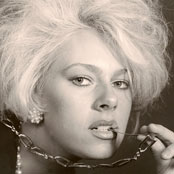
Here's a photo from Rhoda Janzen's professional modeling days . . .
Mennonite in a Little Black Dress -- The Writer's Dilemma

Clearly this Mennonite Writer had a non-Mennonite audience in mind. What I'll warrant she didn't expect, was the interested, passionate, and sometimes hotly critical response of a reading Mennonite public. Thus Janzen's Mennonite Writers' dilemma was less whether or not to tell the "secrets" of family and community, but rather what to do once she had told them in a memoir that nearly everyone wanted or wants to read.
While reviewers from non-Mennonite places noted the affection that Rhoda shows, especially for her mother, to whom the book is dedicated, Mennonites were concerned with which Mennonite story she was telling, whether she got the history right, how she talked about her family, and the embarrassment they were sure her rather unvarnished portraits were causing them. Some of these reviewers weren't above giving Rhoda a good scolding.
One of the more balanced reviews by a non-Mennonite acquainted with Mennonites is by Jessica Baldanzi in the CMW Journal. This book review, to date, received more comments than anything the Journal has published. These comments, which you can read when you access the review online by clicking on Jessica's name above, express a range of Mennonite responses. After we make our own assessments, we'll read some of both kinds of reviews in our class.
Another review from an "Old Mennonite" (aka early immigrant Mennonites to the US) perspective is by Shirley Showalter, former President of Goshen College, on her blog, "100 Memoirs." This review highlights some of the differences between Swiss-descended and Russian descended Mennonite groups.
Shirley also has a very useful guide to Rhoda's use of humor in Humor and Memoir: Seven Ways to Leave 'em Laughing, a guest comment on a blog about women's memoirs.
A balanced review from a non-Mennonite perspective is by Kate Christensen in the Nov. 5, 2009 Sunday New York Times Book Review.
The Mennonite Bestseller

Before Mennonite in a Little Black Dress hit the bestseller lists, it was almost inconceivable to me that any book about Mennonites could garner such a large audience in the United States. Canadian Mennonite Writers have been winning national awards for nearly forty years. Rudy Wiebe's The Temptations of Big Bear won the Governor General's Award in 1973, and Miriam Toews's A Complicated Kindness won the same award in 2004 and was the winning title for Canada Reads in 2006. But in the United States Mennonite Writers are a tiny drop in a huge multicultural salad of writers--and compared to the Amish, who attract huge interest, Mennonites are hard to identify or figure out.
Then along comes Rhoda Janzen with Mennonite in a Little Black Dress. Her editor promised it would be big and she was right. What is the secret of this book's success?
As we began the book, I asked my students to look for "windows" and "mirrors" -- that is, windows that show them and unfamiliar world, and mirrors that reflect their own experience back to themselves.
In our first discussion, they mentioned the ridiculous family car trips, the embarrassingly uncool ways in which her mother uses vocabulary words such as "boner" without understanding their colloquial meaning, the bonding over food, the weird relatives, the frugality, the "lunches of shame." Rhoda makes us laugh and wince over a whole array of "uncool" things in life that she dares to name in a loving and frank, and sometimes snarky way. Rhoda is never far from the scrutiny she casts on the world around her, and she comes in for her share of jokes at her own expense, which makes her a good sport.
I've asked students to identify key topics that recurr in Janzen's memoir that offer both windows and mirrors to readers. At the top of my list are food, the body--especially in its humble, often less than attractive flesh, family, a history that ties the present to the past, and a strong desire to find the good in even the worst events, seasoned with a heavy dash of humor. Many of these topics tie directly into what Janzen shows she appreciates about her Mennonite family.
Subscribe to:
Posts (Atom)